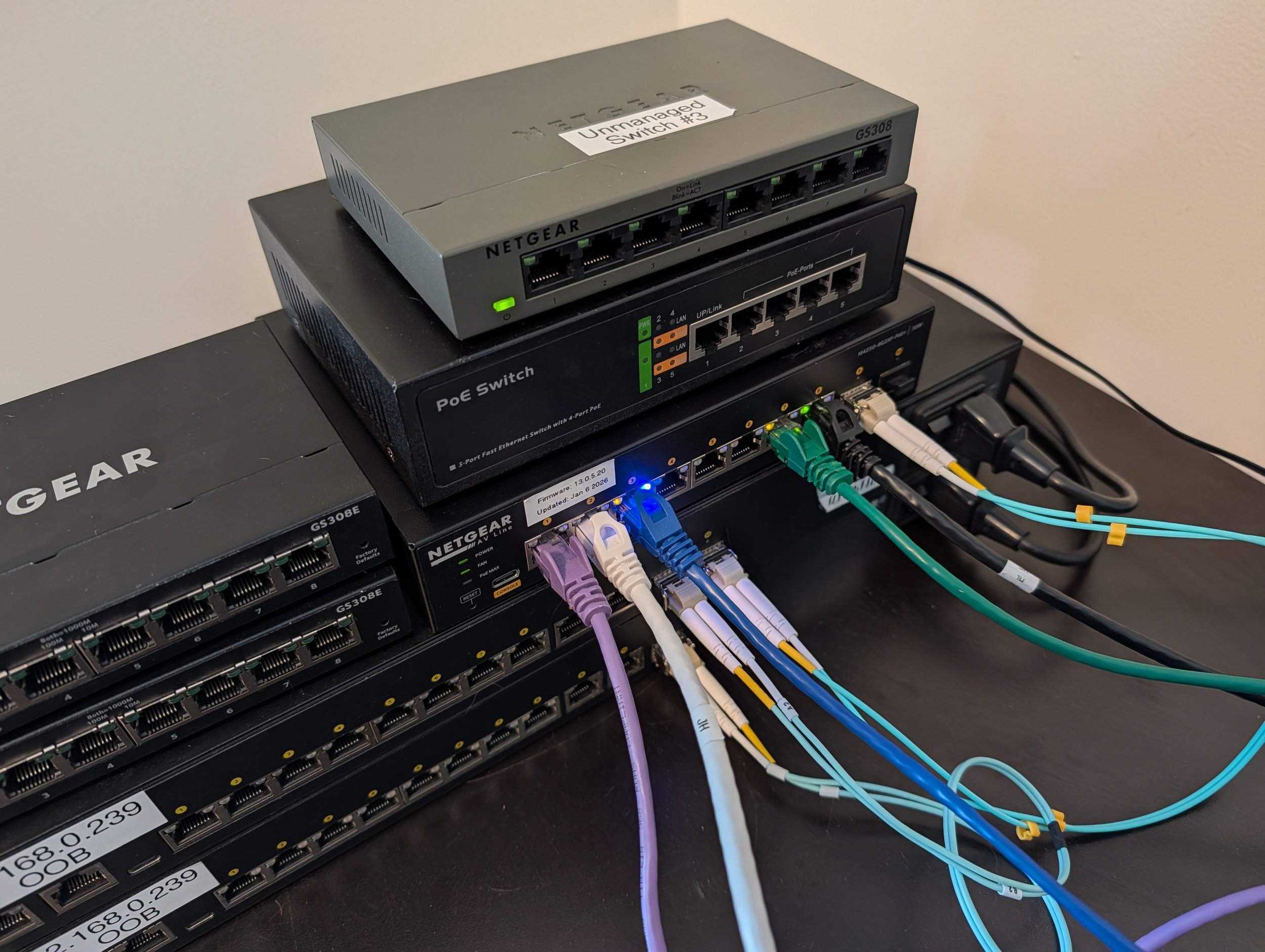
Demonstration of Issues with Multicast and IGMP Snooping in Inexpensive Unmanaged Network Switches for Shows and Entertainment Applications
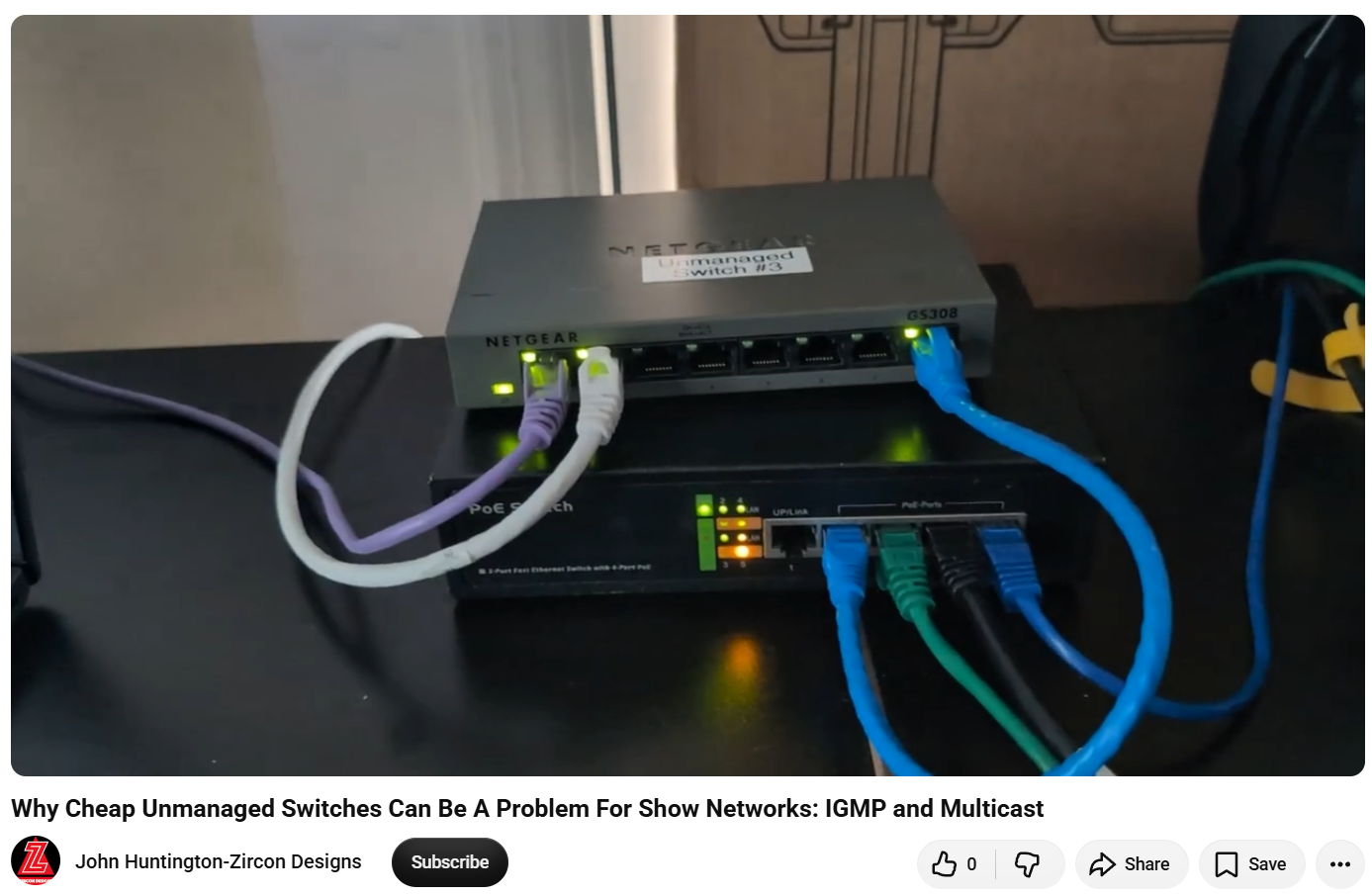
In recent years, the use of multicast has grown and—especially in lighting control—has created some issues, especially when running cheap, unmanaged switches. For me, I have to see things to understand them, so I set up a bunch of computers and switches in my little lab space, and did some experiments; then I made a video to share with you.
Here’s the video description:
Show networks are now a backbone technology for live shows. However, not all network switches are created equal. One problem with cheap, unmanaged switches is that they don't handle multicast well, and multicast is widely used in lighting control for sACN, in audio distribution using protocols like Audinate's Dante, and some video streaming protocols. In this video, John Huntington, author of Introduction to Show Networking, demonstrates some of the issues with multicast when not well implemented.
As usual, much more information on show and entertainment networking in my book.
Here’s the video:
August 2, 2026 Update: Benefits and Disadvantages of Various Switch Types For Show Networks
I thought this video would get a few views but as of today it’s over 1200, and I’ve gotten a few comments I thought I’d address.
First, the video was really just intended as an exploration of IGMP snooping as part of a larger expansion of material for a future edition of my book (more posts on multicast and other topics in progress and coming soon). I don’t have enough subscribers to even monetize my YouTube account, but I did write click-baitish headlines for the YouTube algorithm. I just started this channel; most of my stuff is on (paid, ad-free) Vimeo, but YouTube itself is a traffic source these days. But in any case, in the video, I was never intending to make a comprehensive guide to selecting a switch for a show. I (obviously) didn’t script it, and I did make a few offhand comments which people disagreed with or said were wrong.
I lay out my whole process for network system design and my best practices in my book, and my general design approach is based on the goal of having a mental model of how the systems work to help design, set up, configure, and operate networks. To me, part of the goal of that process is also to have operational visibility into the network.
In addition, in the book I talk about VLANs and all kinds of other ways to manage network traffic. But in any case, a few further thoughts on types of switches commonly used in show applications:
Cheap, Consumer-Grade Unmanaged Switches:
I don’t recommend these for all the reasons I mention in the video, including the cheap power supply and unknown IGMP Snooping status. Again, if you’re just connecting a lighting console and a couple LED fixtures and not on tour or something, the system may operate perfectly for years. But in addition to limitations I mention in the video, it’s kind of scary to me to have no visibility into the switch. In the old days (my first networks were in the mid 1990s), hubs were electrical, Layer 1 devices and there really wasn’t much to see or understand inside beyond the circuit board. But those $20 unmanaged switches in the video have Energy Efficient Ethernet (EEE) permanently turned on; Audinate, for example, recommends EEE be turned off if you’re running Dante. Could a show be run on these without incident? Sure. Is it worth taking that chance? Not for me.
And speaking of Dante, a few years ago they added a feature that allows you to monitor the latency performance of streams on the network; for me, that was a game changer. With that, I can look inside the system and get an indication of system health. Without that, I could be running on the bleeding edge of failure and have no idea. That’s the nature of digital: it works perfectly until it doesn’t. In the analog era, we could tell when a problem was developing: a hum in the sound system, flickering lights, noise bars in a video, etc. Someone messaged that they built a huge network out of the unmanaged switches in the video, and for me, that would be scary. It might work perfectly forever; it also could suddenly catastrophically fail because you didn’t realize you were running the system at 99%, and something changed to push it over the edge. Even some of the cheapest managed switches allow you to do some monitoring.
Also, I mentioned in the video, but some switches can also have multicast group limitations that are not even documented. There was a fantastic article about this by Mike Wood in ESTA’s Fall 2017 Protocol magazine; additionally, Singularity wrote some software to test multicast groups, and they have published their results with a bunch of switches in a table.
Here’s a little snippet to show you how crazy this is, check their site for more:
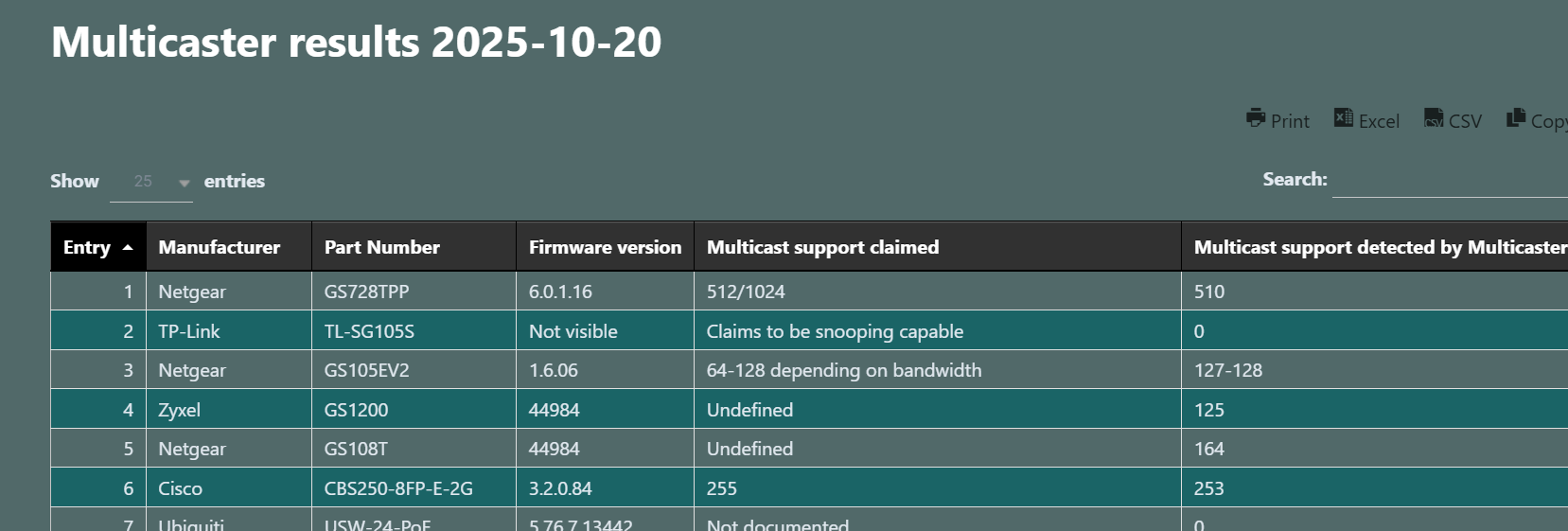
Sample of results from Singularity’s Multicaster test software; go to their site for the full details.
Cheap unmanaged, consumer grade switches are a black box designed for other industries. Use these if you like, but I wouldn’t use them for a show-critical application.
Cheap, Consumer-Grade Managed Switches:
I don’t recommend these for some of the same reasons as above. I mentioned the power supply, but to me that’s a big deal. After troubleshooting show systems for 40 years, a large percentage of problems I’ve seen have been power or connector related. But at least a managed switch is an improvement over an unmanaged switch because you can see the status of things like IGMP snooping and EEE and hopefully get some idea of the memory and processor load. You can also get into trouble with these (or any managed switch, reallY) if you don’t check and find that a switch has an old configuration that isn’t right for your intended application (like half the interfaces are in a different VLAN).
But if you know what you’re doing, you can make these work well, but I think better solutions (see below) are available and pretty affordable these days. And running a $2000/$20000/$50000/$100000 lighting console or mixer and connecting it with a $30 switch? That just doesn’t make sense to me; you get what you pay for.
Show-Specific “Unmanaged” Switches:
There’s a bunch of these now targeted at various departments. There’s some for sound distribution that have no external controls at all; others for lighting I’ve seen are specifically configured for the nature of lighting protocols like sACN. You can see pictures of some of these in my various posts on Infocomm and so on. These really are managed switches, but, typically, the management has been done by someone for our industry (one brand I saw was actually a repackaged Cisco small business switch). That also means there’s someone who understands our industry to contact if there’s a problem; support is critical in our 24/7 industry. These switches typically also have more serious power supplies and the option for Ethercon connectors and possibly even fiber and so on. Some of these are well designed, well supported and can work fine in many kinds of applications. I haven’t explored these in detail since for my needs these days (teaching workshops) I need to get under the hood. But for me, for straightforward show applications, these switches can be a good solution and would be the sort of baseline I would recommend.
Small Business Grade Managed Switches:
If you spend some time to learn how to configure these, small-business grade IT stuff can be an effective choice and is made for professional operations. I ran the Gravesend Inn haunted hotel on two generations of Cisco Small Business stuff for a decade or so and have posts on that link describing what we did; it worked very well. However, that was a decade+ ago, and, for me, these days, real “Show-Grade” switches are in the same ballpark pricewise, so I would recommend them instead.
Show-Grade Switches:
There’s at least three manufacturers now that I know of today (Pathway, Luminex and Netgear AV by order of market entry) who design managed switches from the circuit board level up for our applications. These have been becoming increasingly affordable and powerful in recent years as our market has grown, and all three of these companies understand the support needs of our market (which is also why they can be a bit more expensive; you get what you pay for).
Complex lighting and video networks, in particular, are starting to require some specific configuration (PTP, IGMP, etc) to really work properly. I went to a seminar at ETC in NYC last year where they were talking about how the switches and their performance are really a critical part of a modern lighting control system; if things aren’t configured right, the system can have real problems.
All three of these companies also have software interfaces that are straightforward to use, and targeted to our applications. These would likely be a bit more expensive than the Show-Specific unmanaged switches, and only a bit more complicated to use. But they also offer excellent training; I learned a bunch from the in person Luminex training, and recently took and passed the Level 1-3 Netgear AV certification, which also was very good and is offered at no cost to the participants.
Enterprise-Grade Switches
Obviously, these can do the job, but the learning curve on these is pretty steep, and you need to keep that level of technical support available for the life of your project. Some place like the Sphere or a large theme park has built this support level into their operations, so it makes sense in those applications. But even if you have one IT expert in your facility or on tour with you who can configure things for the show, would they be available at midnight during load in to help interface the touring console to the house lighting rig? Also there’s a lot of stuff in these switches that we typically don’t really need (I failed the second half of CCNA because it’s all about routing, and I just couldn’t be bothered to remember all that stuff that we rarely use, but I did pass CCENT), and one wrong check box can cause all kinds of problems. And for me, if I never see another CLI switch configuration that will be fine with me :-)
In Summary
I try pretty hard to never say there’s a “right” or “correct” way to do anything (although I may slip a bit if I see you at the bar). I try to just lay out what I think is important to know and then tell you what I would do. It’s up to you to make your decision based on all the parameters of your application.